Asia's Environmental Movements: Comparative Perspectives by Alvin Y. So & Lily Xiao Hong Lee
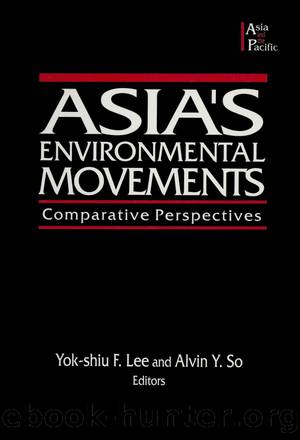
Author:Alvin Y. So & Lily Xiao Hong Lee [So, Alvin Y. & Lee, Lily Xiao Hong]
Language: eng
Format: epub
Tags: Political Science, General
ISBN: 9781563249082
Google: CCdZHRTkFpAC
Goodreads: 2209982
Publisher: Routledge
Published: 1998-10-31T00:00:00+00:00
Key Players
Membership in the environmental movement is marked by a mix of players with varying organizational features and levels of engagement. The key participants fall into three major clusters: (1) a non-government organization (NGO) cluster, (2) a peopleâs organization (PO) cluster, and (3) a local community (LC) cluster. These are not exactly exclusive of one another, as numerous alliances and collaborative efforts are often forged across the various clusters.
The most active members in the NGO cluster can be categorized, based on their organizational history, either as environmental NGOs that became development-oriented, or as development NGOs that turned environmentally sensitive. The first category involves the transition of a conservation NGO like the Haribon Foundation into a leading advocate for local community control over natural resources. The second category is represented in the creation of the Convergence for Community-Centered Area Development (Convergence), an alliance of eighteen development NGOs that declared their commitment to a community-centered area approach in the propagation of economic self-reliance, popular empowerment, and ecological sustainability. The marriage of environmental protection and developmental goals in the strategic agenda of these two sets of groups transformed them into what we may refer to as sustainable development NGOs. These play an important role in providing organizational, educational, and technical support to POs and local communities in negotiating resource rights, conducting resource inventories, crafting livelihood programs, fighting ecological plunderers, and protecting nature.
Included in the PO (Peopleâs Organization) cluster are sectoral groups and mass organizations which, under authoritarian rule, were routinely mobilized for human rights and social justice campaigns. In recent years, the traditional clamor of POs for social redistribution policies in the agricultural and fishery sectors were laced by sustainable development demands. Farmersâ groups in the Congress for a Peopleâs Agrarian Reform program (CPAR) are exploring regenerative agricultural strategies, while fishersâ groups belonging to the National Coalition of Fisherfolks for Aquatic Reforms (NACFAR) collaborate with NGOs in the application of coastal resource management programs.
The LC (Local Community) cluster is represented by the various instances of environmental protests launched by informally organized local residents and the church. Unlike POs, which may also be community-based, LCs are not necessarily organized in terms of having well-defined programs of action or formalized membership structures. In this sense, local acts of resistance may best be seen as expressions of a victim activism possibly difficult to sustain (Hsiao, Milbrath, and Weller 1995). Collective energies dissipate in the long run when left un-channeled into more organized patterns of engagement. Nevertheless, protest activities undertaken by small Philippine communities and the church have, in the past, served as springboards for larger campaigns.
The dynamic creation of environmental task forces and coalitions that slice through sectoral boundaries and organizational clusters led to thickening webs of interdependence among ecologically concerned NGOs, POs, and LCs. Such a process is vital, not only in sustaining citizensâ participation in environmental activities, but also in building trust and cooperation among different groups by enabling them to engage in the joint enterprise of formulating a coherent agenda and a strategy for sustainable development.
Download
This site does not store any files on its server. We only index and link to content provided by other sites. Please contact the content providers to delete copyright contents if any and email us, we'll remove relevant links or contents immediately.
| Anthropology | Archaeology |
| Philosophy | Politics & Government |
| Social Sciences | Sociology |
| Women's Studies |
The Secret History by Donna Tartt(19088)
The Social Justice Warrior Handbook by Lisa De Pasquale(12190)
Thirteen Reasons Why by Jay Asher(8909)
This Is How You Lose Her by Junot Diaz(6887)
Weapons of Math Destruction by Cathy O'Neil(6279)
Zero to One by Peter Thiel(5802)
Beartown by Fredrik Backman(5754)
The Myth of the Strong Leader by Archie Brown(5507)
The Fire Next Time by James Baldwin(5444)
How Democracies Die by Steven Levitsky & Daniel Ziblatt(5218)
Promise Me, Dad by Joe Biden(5153)
Stone's Rules by Roger Stone(5088)
A Higher Loyalty: Truth, Lies, and Leadership by James Comey(4963)
100 Deadly Skills by Clint Emerson(4925)
Rise and Kill First by Ronen Bergman(4789)
Secrecy World by Jake Bernstein(4753)
The David Icke Guide to the Global Conspiracy (and how to end it) by David Icke(4718)
The Farm by Tom Rob Smith(4509)
The Doomsday Machine by Daniel Ellsberg(4490)
